“Flow”, the Oscar made with free software: watch it on ARTE, and take it as an invitation
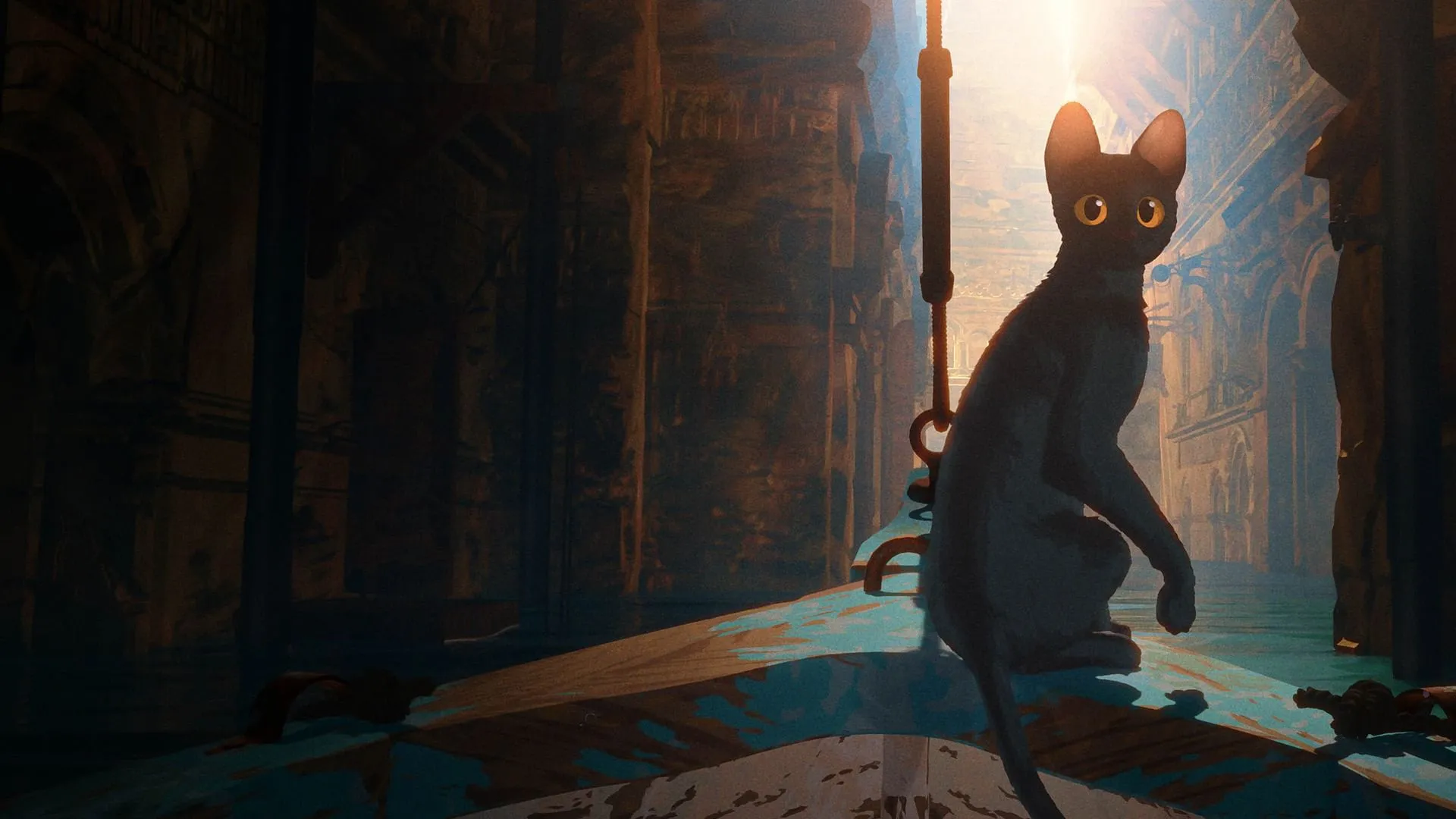
A small black cat, a flood that swallows the world, a boat shared with a capybara, a lemur, a dog and a bird. Not a single line of dialogue. Flow, by Latvian director Gints Zilbalodis, won the Oscar for Best Animated Feature in 2025, ahead of Pixar’s Inside Out 2 and DreamWorks’ The Wild Robot. And right now it is free to watch on arte.tv, until 27 January 2027.
The film deserves to be seen for what it is: a wordless odyssey, beautiful and gripping, to share with the whole family. But it also deserves to be watched for the way it was produced and made: €3.5 million, free software, a small team, three countries. That story concerns us directly.
Watch it on ARTE
- Where: Flow on arte.tv, free, no subscription (streaming available in France);
- until: 27 January 2027;
- running time: 82 min;
- on television: Tuesday 29 December at 8:55 pm on ARTE.
The film’s French trailer, released by UFO Distribution.
The production: a Latvian film, made across three countries
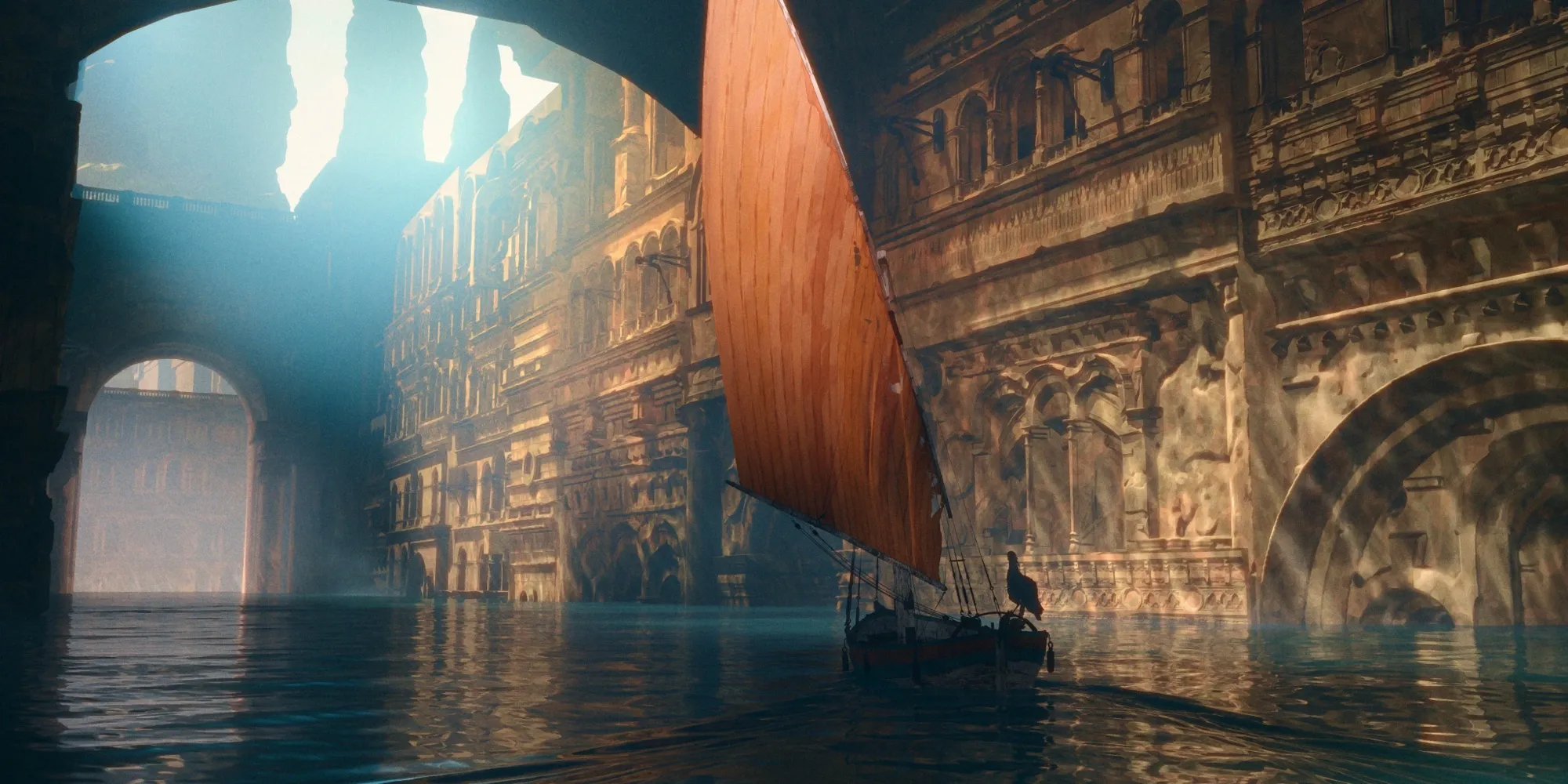
The animals’ sailing boat, in a sunken city. Image: “Flow” © Dream Well Studio, Sacrebleu Productions, Take Five, UFO Distribution.
Flow did not come out of a big studio. It is a European co-production put together by small independent companies.
- Dream Well Studio (Riga, Latvia), the majority producer, led by producer Matīss Kaža and Gints Zilbalodis himself;
- Sacrebleu Productions (France), Ron Dyens’s company;
- Take Five (Belgium), Gregory Zalcman’s company;
- with ARTE France Cinéma, RTBF and Canal+, and Charades handling international sales.
According to Unifrance, the film is 45% Latvian, 45% French and 10% Belgian. The balance was a close one: the head of the National Film Centre of Latvia has said that the film almost became majority French, before Matīss Kaža brought together enough Latvian and European funding to keep control of it (CEE Animation interview).
Who did what
Each country took on part of the work, as Ron Dyens explained to the CNC:
- in Latvia: all the pre-production (visual development, sets, textures, 3D staging), the lighting, the rendering and the recording of the music;
- in France: most of the preparation of the characters for animation (the rigging) and of the animation itself, in Paris and above all in Marseille, as well as the sound design;
- in Belgium: part of the animation, in Brussels, and the mix.
The financing
The budget was around €3.5 million. A Pixar film often costs more than 150 million. The money came from many different sources, each contributing its share:
- the National Film Centre of Latvia, around €1 million over four years, and the Latvian state culture fund;
- France’s CNC (national film centre), with several grants (support for animation techniques, an advance repayable from box-office receipts, development support and distribution support);
- Eurimages, the Council of Europe’s film fund, for €400,000;
- the Région Sud (Provence-Alpes-Côte d’Azur) regional fund, for the part made in Marseille;
- the broadcasters ARTE, Canal+ and RTBF.
The timeline
According to the interview published by Blender, it took about five and a half years:
- 2019: writing, learning Blender, first search for funding;
- 2020: first funding secured;
- 2021: the artists in charge of sets and visual development come on board;
- 2022: Sacrebleu and Take Five join the project;
- 2023: production in full swing, and first images shown at the Annecy Festival;
- May 2024: world premiere at the Cannes Film Festival, in the Un Certain Regard selection.
A small team
The Latvian studio had 15 to 20 people, and often only three to five were working at the same time. The animation was entrusted to around twenty animators, spread across Paris, Marseille and Brussels, who completed it in six months, at a rate of about two seconds of film per day per animator.
A box-office success
Released in France by UFO Distribution from 30 October 2024, the film sold more than 750,000 tickets there. Worldwide, it took more than €50 million, according to Variety, more than fourteen times its budget. In Latvia, it became the most watched film in the country’s history.
Blender: how the film was made
Gints Zilbalodis, born in 1994, had made his first feature, Away (2019), on his own, over more than three years, using paid software. For Flow, in 2019 he switched to Blender, a free and open-source 3D program developed by a foundation and a community of volunteers. He chose it mainly for EEVEE, its real-time render engine: the image appears almost finished while you work.
The official making-of: the director and the team show how the film was made in Blender. In English, subtitles available. Video: Janus Films.
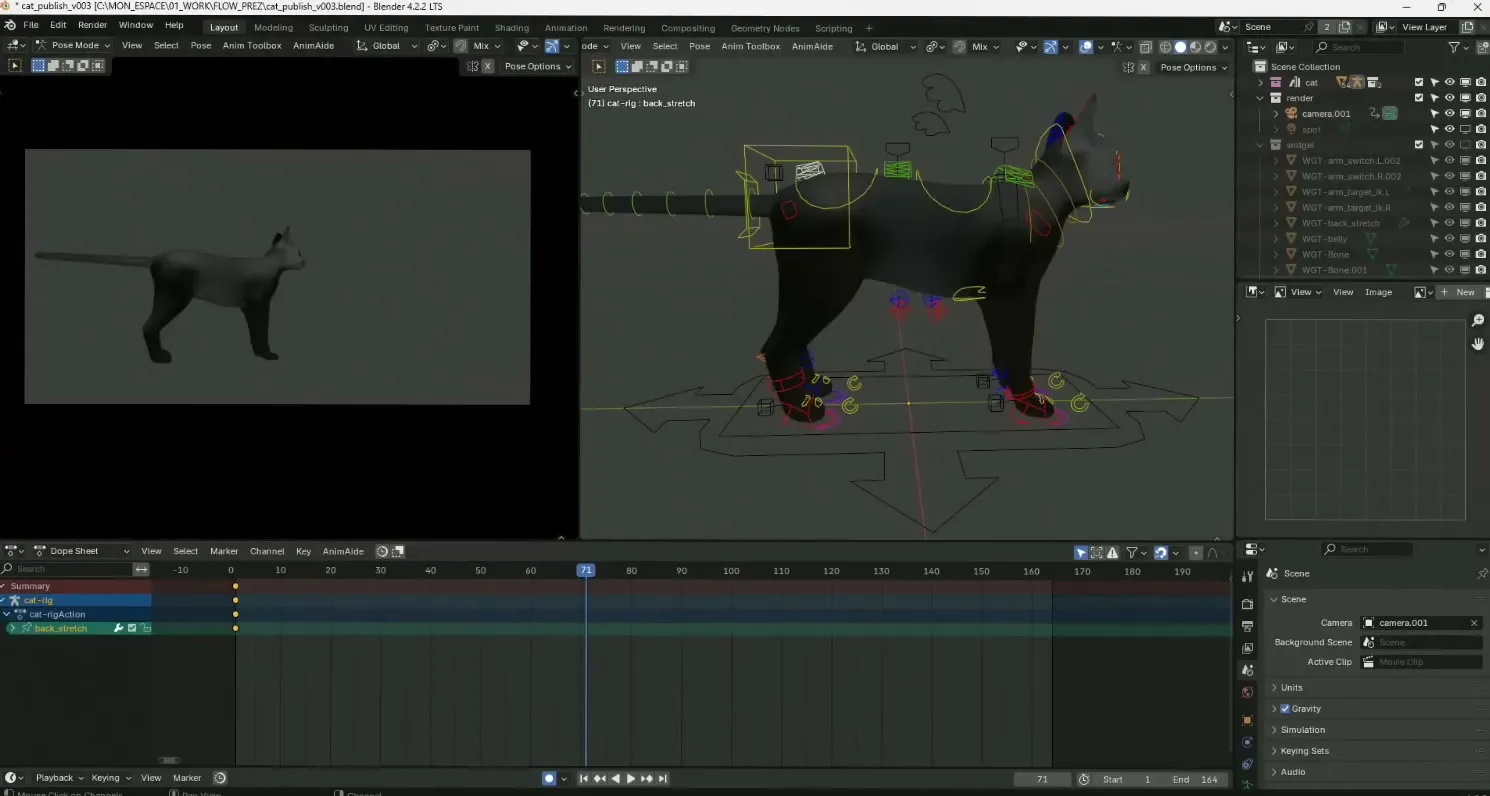
The cat in Blender, with its animation controls, presented by the animation director. Image: Léo Silly-Pélissier, Blender Conference 2024, Blender Foundation, CC BY.
No storyboard, a handheld camera
No drawn storyboard: the director builds the sets directly in 3D, then moves a virtual camera through them, like a camera operator on a real shoot, with a slight handheld movement added using a Blender add-on. The film has 307 shots in 22 sequences. Some are very long: the longest lasts about 4 min 35 s, or 6,606 frames, and eight animators worked on it before it was reassembled into a single file (VFX Voice).
Animating animals that don’t talk
The shots were too long to be checked frame by frame. So the team wrote behaviour rules for each animal: for example, how the cat turns its ears when it is listening. The animators worked from reference videos, went to observe the animals at the zoo, and the director’s own cat served as a model. Most of the animators came from other software: they learnt Blender in less than a week.
Light, water and rendering
- The light: Gints Zilbalodis lit the entire film himself. No compositing stage: the colours are set directly in the materials, and what you see on screen is the final image.
- The water, present in almost the whole film: only two people worked on it. Mārtiņš Upītis built a custom tool with Blender’s Geometry Nodes, and Konstantīns Višņevskis handled the splashes as well as the stylised rendering of fur and feathers. The water tool is now sold to all Blender users, for around fifty dollars.
- The rendering: each 4K frame took between half a second and ten seconds to compute. No “render farm”, those rooms full of machines that crunch away for weeks: the final render was done on the director’s own computer.
- The style: simplified, almost graphic characters in more realistic settings, in the manner of 2D films with painted backgrounds.
One shot, from the first rough layout to the final image, in 19 seconds. Video: Gints Zilbalodis.
The flood scene, step by step: from the animatic to the final image. Video: Mārtiņš Upītis, Physical Addons.
The team also used add-ons created by the Blender community, to scatter vegetation, simulate fluids or animate the camera. Animation director Léo Silly-Pélissier presented their methods at Blender Conference 2024, and Mārtiņš Upītis and Konstantīns Višņevskis took the audience behind the technical scenes at the 2025 edition.
And to hear the team in French, the animation director talks about the making of the film with the CST (Commission supérieure technique de l’image et du son, the French association of film and sound technicians), at the 2024 Cannes Film Festival:
Léo Silly-Pélissier, animation director of “Flow”, in French. Video: CST.
Blender has also paid tribute to the film: the splash screen of version 4.4 of the software, released in March 2025, shows the cat from Flow swimming among fish.
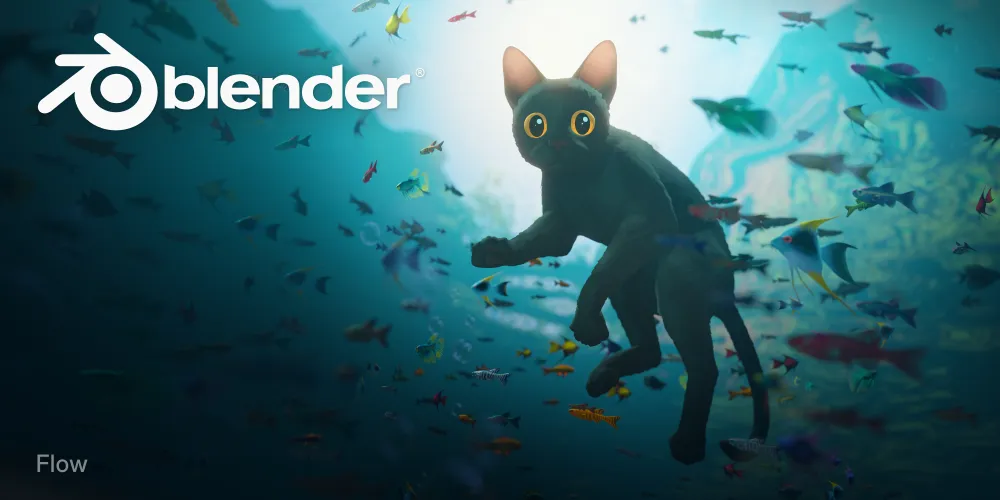
The Blender 4.4 splash screen. Image: “Flow”, Dream Well Studio, Sacrebleu Productions, Take Five, for the Blender Foundation, CC BY-SA 3.0.
When constraint becomes a style
Nothing in Flow tries to imitate the big studios.
No dialogue. The whole story is told through image, movement and sound. The animals make real animal sounds, recorded by the sound team, sometimes at the zoo. Only the capybara cheats: its voice is a baby camel’s. The music, composed by Gints Zilbalodis and Rihards Zaļupe, does the rest.
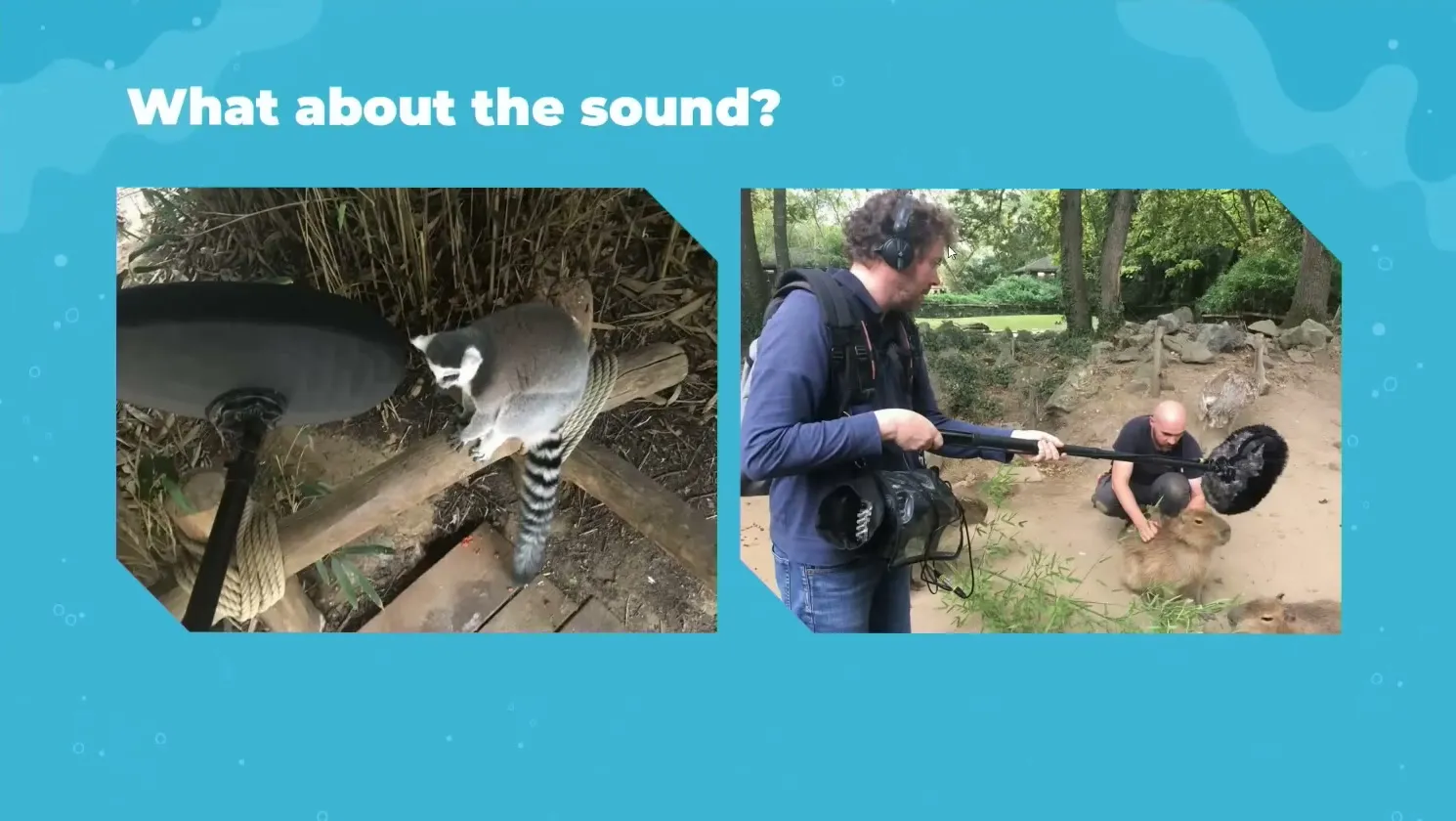
Recording a lemur and a capybara for the film’s voices. Image: Léo Silly-Pélissier, Blender Conference 2024, Blender Foundation, CC BY.
Long takes. The camera stays with the cat, without cutting, and that is what makes the film so immersive.
A home-made tool, then shared. That is the spirit of open source: what one team invents can help the next ones.
The awards: from Cannes to the Oscar
- Cannes, May 2024: world premiere, Un Certain Regard selection;
- Annecy Festival, June 2024: four awards, including the Jury Award, the Audience Award and the award for Best Original Music;
- European Film Awards, December 2024: Best Animated Feature;
- Golden Globes, January 2025: Best Animated Feature;
- Annie Awards, February 2025: Best Independent Feature and Best Writing;
- César Awards, February 2025: Best Animated Film;
- Oscars, 2 March 2025: Best Animated Feature, ahead of Inside Out 2, The Wild Robot, Wallace & Gromit: Vengeance Most Fowl and Memoir of a Snail. The film was also nominated for Best International Feature.
It is the first Oscar in Latvia’s history, and the first time an independent film has won this category. On stage, Gints Zilbalodis said he hoped the award would open doors for independent animation filmmakers, before concluding: “We are all in the same boat.” Speaking to the press, he paid tribute to Blender: in his view, any young person now has in their hands the tools to make an Oscar-winning film, and he plans to use it for his next film (Creative Bloq).
Gints Zilbalodis and his producers, Matīss Kaža, Ron Dyens and Gregory Zalcman, facing the press just after the Oscar. In English. Video: Oscars.
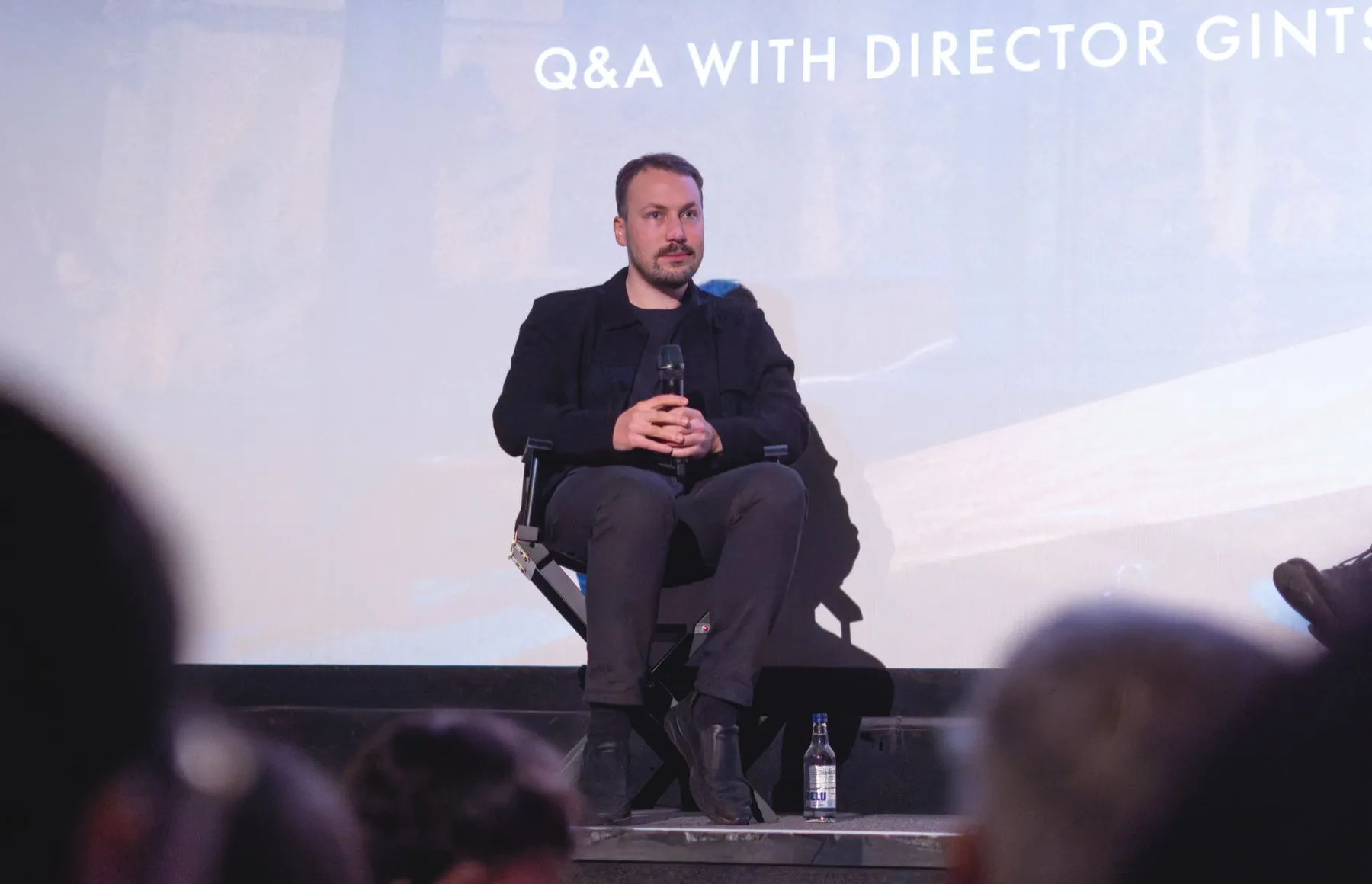
Gints Zilbalodis answers questions from the audience in London, on 2 February 2025, a month before the Oscar. Photo: Raph_PH, CC BY 2.0.
In Latvia, the team was welcomed by several thousand people at the foot of the Freedom Monument in Riga. A statue of the cat was put up in the city, soon joined by its travelling companions, and the central bank even minted a 5-euro coin in its likeness.
Why it speaks to us, here
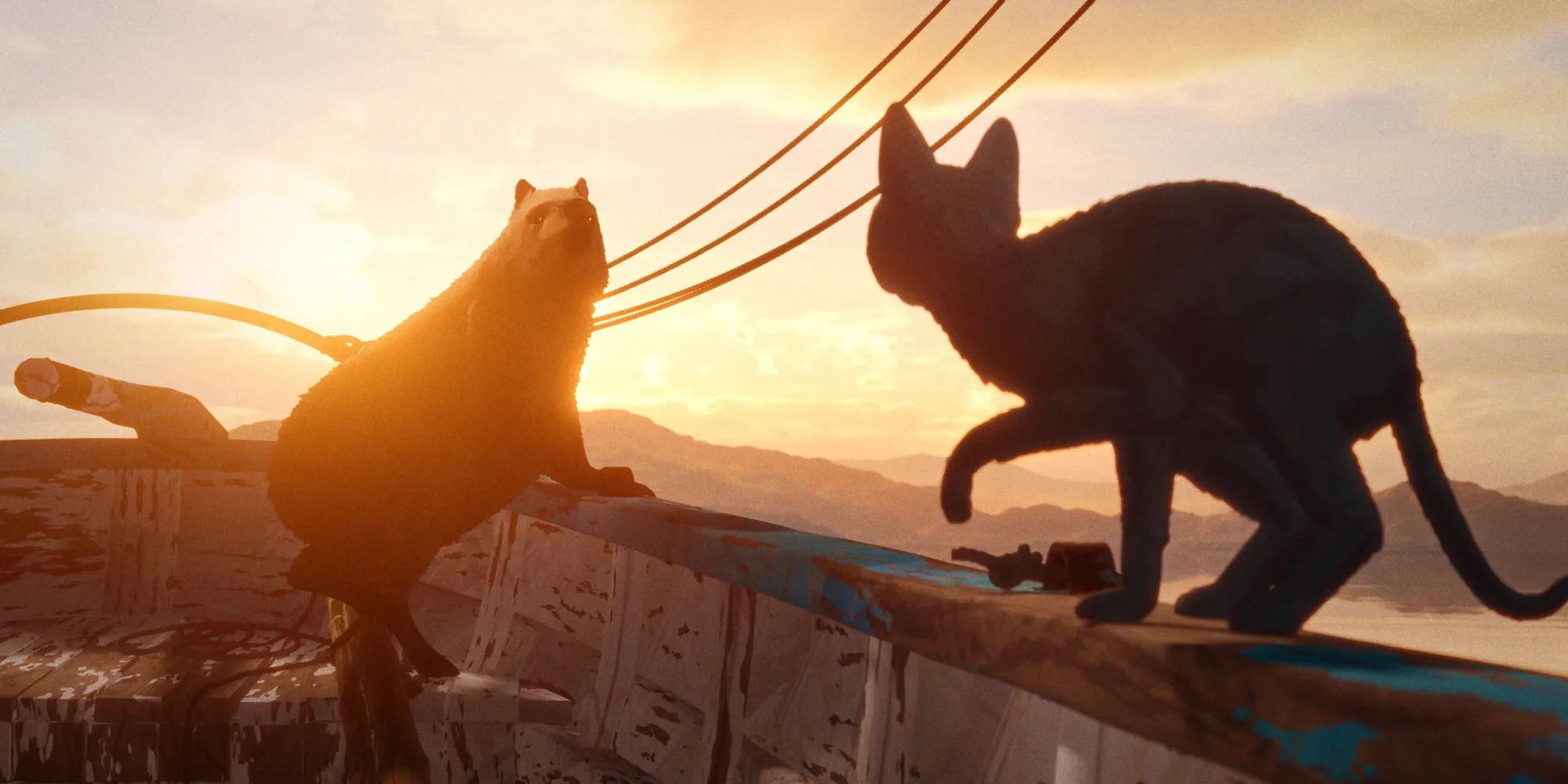
The capybara and the cat, in the same boat. Image: “Flow” © Dream Well Studio, Sacrebleu Productions, Take Five, UFO Distribution.
Latvia has fewer than two million inhabitants. It has no Hollywood, no giant studio, no animation industry comparable to that of the United States or Japan. What it had was a determined director, a small team, free software, co-producers who believed in the project, and a simple story, told without a word, and therefore understood everywhere.
That sounds a lot like what we experience in the Caribbean. We keep being told that we need means we don’t have, machines we can’t afford, studios that are elsewhere. Flow shows that another path exists:
- tools are no longer a barrier: Blender is free, runs on Windows, macOS and Linux, and there are thousands of tutorials, including in French;
- co-production is a strength: a studio in Riga kept control of its film while relying on French and Belgian partners, on the CNC, on a region and on European funds. Our territories also have access to these schemes, and to their own funding;
- constraint can become a signature: no dialogue, long takes, a stylised look rather than photorealism;
- a small team can aim for the world, provided it is well organised and shares out the work;
- our stories need no translation when they are told through images: the sea, storms, rising waters, solidarity among those in the same boat… we know all about that.
It is not a magic formula: Flow also took five and a half years of work and a real budget. But it is an invitation to stop waiting for permission, and to find our own way of doing things.
Further reading and watching
To watch
- “Conversation with Gints Zilbalodis”, on arte.tv (in French), 5 min;
- Gints Zilbalodis’s interview with 3DVF, in English with French subtitles, 16 min;
- the interview at the Strasbourg European Fantastic Film Festival, in English with French subtitles, 15 min;
- “The animation of Flow”, Léo Silly-Pélissier’s talk at Blender Conference 2024, in English, 58 min;
- “A glimpse into Flow”, the technical behind-the-scenes at Blender Conference 2025, in English, 27 min;
- the making of a scene, told by the director, for the European Film Academy, in English, 4 min;
- Gints Zilbalodis’s reaction after the Oscar, for The Hollywood Reporter, in English, 5 min.
To read
- Gints Zilbalodis’s interview with Blender, in English, the most detailed account of how the film was made;
- Ron Dyens’s interview with the CNC (in French), on the co-production;
- “Charting a new course for Flow”, in VFX Voice, in English, on the long takes, the water and the animation;
- the film’s official website and its Wikipedia page.
What now?
First, watch the film. On your own, with your family, your students or your team: Flow is on arte.tv until 27 January 2027.
Then, if animation appeals to you, install Blender and get started. And if you already work in 3D, animation or visual effects, make yourself known: create your profile on CFCDb so that productions can find you. Animation roles have their place there, and the directory already lets you find animators from the Caribbean.
The next Flow could very well come from here.
Cover image: “Flow”, Gints Zilbalodis, Dream Well Studio, Sacrebleu Productions, Take Five, ARTE France Cinéma.
Want to talk about it, join a project or share news? Meet the community on Discord. discord.gg/cfcdb
Read next
 “Harmony”: the first Canal+ original series from the French overseas territories is GuadeloupeanNovember 26, 2026 · 8 min read
 Trinidadian filmmaker Shari Petti relaunches her website: a visualizer for esperanza spalding, vlogs and her photographs exhibited in FranceNovember 22, 2026 · 2 min read
 Les Révoltés du Monde: on Monday 23 November, the festival heads out across Martinique with “Climat : des résistants en Outre-mer”November 22, 2026 · 2 min read